
Sentiment as the Hidden Energy Behind a 5-Star Trade
Sentiment as the Hidden Energy
Behind a 5-Star Trade
When crafting a 5-star trade in the financial markets, the goal is to align multiple dimensions of analysis—technical, fundamental, and sentiment—into a cohesive strategy. While technical charts and fundamental data are well-known cornerstones, sentiment analysis is often the underrated force that adds depth and clarity to a trade setup. Think of sentiment as the hidden energy that drives price movements, builds momentum, and reflects the psychological state of the market. It’s the “Z-axis” of trading, complementing the X (time) and Y (price) axes that define patterns and trends.
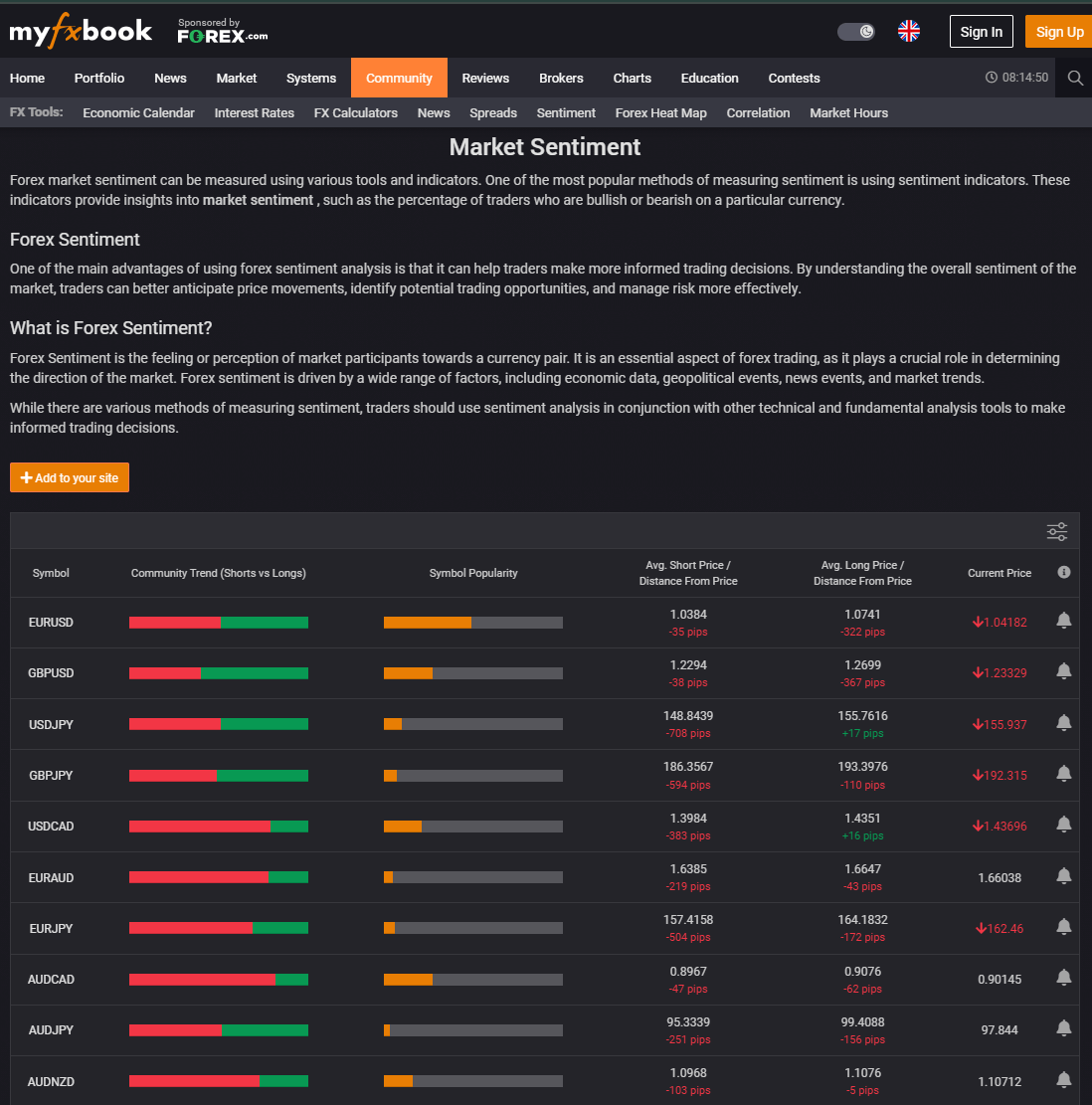
The Forex Sentiment data provided in the screenshot exemplifies how sentiment serves as a window into the collective outlook of traders, enabling smarter, more informed decision-making.
What Does Sentiment Reveal?
The screenshot below from MyFXBook shows the market sentiment for various Forex currency pairs, offering a snapshot of Community Trend (Shorts vs. Longs), Symbol Popularity, and the relationship between short/long price averages and the current price. Here’s how this data can be interpreted and used as part of a 5-star trade setup:
Community Trend (Shorts vs. Longs):Reflects the proportion of retail traders who are long (bullish) versus short (bearish) on a given currency pair. Example from the data:For EUR/USD, sentiment shows a balanced split between shorts and longs, reflecting indecision or a lack of clear trend dominance. This suggests the pair might be consolidating.
Symbol Popularity:Highlights how heavily traded each pair is relative to others. Popular pairs often exhibit more predictable trends and stronger reactions to sentiment. Example:EUR/USD and GBP/USD have high popularity, making them prime candidates for sentiment-driven setups, particularly during active trading sessions.
Short/Long Price Averages vs. Current Price:Displays the average entry price for traders holding short and long positions, as well as how far these prices are from the current market price. Example:For USD/JPY, the average short price is at 148.8439 (708 pips above the current price), while the average long price is at 155.7616 (117 pips above). This suggests shorts have an advantage, and the sentiment is leaning bearish overall.
How to Use Sentiment in a 5-Star Trade
1. Identify Sentiment Extremes for Contrarian Opportunities
When sentiment is heavily skewed (e.g., over 75% of traders are long or short), it often indicates that a reversal is near. Retail traders tend to be wrong at extremes, making these scenarios valuable for contrarian trades.
Example from the data:EUR/JPY: Sentiment indicates more shorts than longs, with the average short price (157.4158) significantly above the current price (162.456). This mismatch between sentiment and price action may signal a potential bullish continuation as shorts get squeezed.
2. Combine Sentiment with Technical Patterns
Sentiment becomes even more powerful when it aligns with technical chart patterns. Look for:
Bullish Breakouts: High sentiment divergence where shorts dominate but price forms a bullish breakout pattern.
Bearish Breakdowns: Overwhelming long sentiment paired with a bearish technical setup.
Example:GBP/USD: The current price (1.23329) is below the average long price (1.2699) and near the average short price (1.2294). Combined with bearish sentiment, this indicates the possibility of further downside pressure, particularly if the pair breaks below key technical support.
3. Validate Sentiment with Fundamental Analysis
Sentiment can act as a compass, but it must align with the broader fundamental landscape. For example:
If sentiment shows an overly bearish market on AUD/USD, but the Reserve Bank of Australia announces a surprise rate hike, the fundamentals could override sentiment, pushing the pair higher.
Example from the data:AUD/JPY: The pair’s sentiment is skewed, with shorts outweighing longs, but its proximity to a key price level (94.4975) combined with strong commodity demand for Australia could result in a reversal.
4. Use Volume as Confirmation
Sentiment is incomplete without volume validation. When sentiment extremes align with a breakout or reversal accompanied by high trading volume, the trade setup becomes significantly more reliable.
Sentiment as a Predictor of Market Psychology
The MyFXBook sentiment table also illustrates how trader psychology plays a role in market behavior:
Consolidation Patterns:Balanced sentiment (e.g., EUR/USD) often occurs during periods of consolidation, where traders are waiting for a breakout catalyst.
Actionable Tip: Look for technical patterns like triangles or ranges to time a breakout trade.
Breakout or Breakdown Signals:Sentiment extremes combined with current price proximity to average long/short levels can signal an impending breakout or breakdown. Example:AUD/NZD: Current price (1.1072) is close to the average short price (1.0968). A sustained move higher could trigger a short squeeze.
Why Sentiment Alone Isn’t Enough
While sentiment provides valuable insights, it should not be the sole basis for a trade. Here’s why:
Sentiment Can Be Irrational:Retail traders often act emotionally, leading to sentiment extremes that are unsustainable. Without technical or fundamental validation, following sentiment alone can lead to poor decisions.
News Events Override Sentiment:High-impact news (e.g., central bank decisions, geopolitical developments) can invalidate sentiment trends and create sharp price reversals.
Volume Adds Credibility:Sentiment must be paired with volume to ensure that price moves are backed by genuine participation. Putting It All Together: A 5-Star Trade Framework
To create a 5-star trade using sentiment, follow this framework:
Time (X-Axis):Focus on active market sessions (e.g., London or New York overlaps) where sentiment trends are most reliable.
Price (Y-Axis):Identify key levels (support, resistance, Fibonacci retracements) where price is likely to react.
Volume (Z-Axis):Use volume spikes or divergences to confirm sentiment-driven moves.
Fundamentals:Align sentiment with economic releases, central bank policies, and macroeconomic conditions.
Technical Analysis:Use chart patterns (e.g., triangles, flags, double tops) to validate sentiment-driven setups.
Conclusion: Sentiment as the Energy Behind the Trade
The MyFXBook sentiment data serves as a perfect example of how market psychology drives trading opportunities. By incorporating sentiment into the 3D framework of time, price, and volume, traders can better understand the emotional energy behind price movements and position themselves for high-probability trades.
Remember, sentiment provides context, but it must be balanced with technical structure and fundamental insights to qualify as part of a 5-star trade. Use sentiment as your compass, but let time, price, and volume be the map that guides you to trading success.
©2025 Pro Series Profits & CSA5Steps. All Rights Reserved.